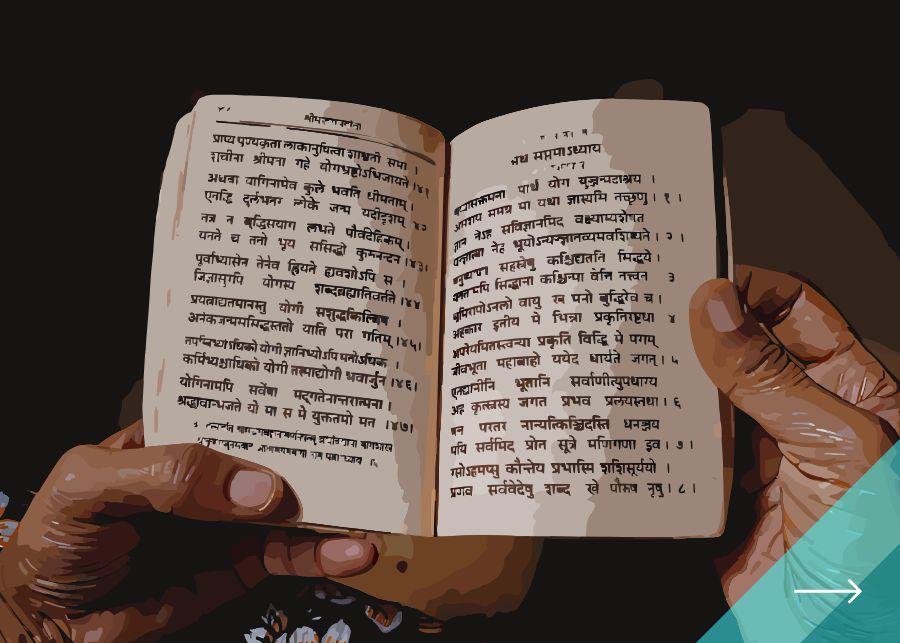
What comes to your mind when you think of Sanskrit?
Prayers? Shlokas? God? Mythology? Culture? Or maybe spirituality? Ramayana? Mahabharat?
The Limited View of Sanskrit
All this holds truth. All these are the jewels of Sanskrit literature. But defining Sanskrit with only this is like saying that an elephant means the trunk. The trunk is a part of the elephant. A definitive one, it’s the differentiator of course. But the elephant is not the same as trunk. This is a very limited definition. I strongly believe the same has happened with our perspective about Sanskrit. We associate Sanskrit with the only aspects of it that we are aware of. And make our limitation of knowledge, the limitation of Sanskrit.
When we talk about Sanskrit today, we usually link it only to spirituality or some vague idea of connecting with our roots. Sanskrit literature does consist of beautiful and interesting mythological stories, enchanting prayers and amazing hacks into spirituality. But that’s just the trunk of the elephant. There’s more to it!
A Civilization of Diversity
Let’s travel back for a while, to the era when Sanskrit was being used widely. Can you recall the land where it was used? Yes, India. Back then it included the entire Indian subcontinent, extending up to the current Afghanistan and Himalayas in the North, and Indian ocean in the South. A geographically blessed territory, lying close by the equator.
A land with maximum geographical variety. Nature here changes its attire at every mile, every season, every moment. A land with deserts but also the oceans, plateaus and plains, huge giant mountain ranges and the forests, with rivers and mines. All kinds of flora and fauna, minerals, gems, herbs. Rich cultivable land with a variety of soil. Vivid landscapes. Variety of animals, birds, insects, trees, herbs, shrubs, flowers, vegetables, fruits, and all possible natural aspects.
As beautiful as this diversity is, it means adopting a diverse lifestyle too. Each variety poses a different risk and way of dealing. The more the forests, the more risk of attacks from animals and insects. Changing weather causing constantly changing environment.
A different way of living in the deserts, different for forests, different for mountains, and yet different for snow lands. Each landscape requires an in-depth understanding of it, to live and flourish on it successfully. Same with the resources available. Indian land has a lot of resources available. However, availability isn’t the key, it is knowledge and innovation.
The Birth of Disciplines
The ancient people must have built houses, for safety from animals or weather. Maybe hay-houses at first, but those wouldn’t have survived in the winds and rains. So, then they must have learnt and re-learnt and refined their skill at building houses. That should be how they learnt the art of architecture.
What if someone was bitten by a snake or an insect? Or someone fell sick due to the weather conditions? That’s how medicine came into picture. They used the available herbs and resources but soon their knowledge expanded. As is said, necessity is the mother of invention. Their knowledge of medicine developed to the peaks of intricate surgeries. This development in the field of medicine led to the development of many allied fields simultaneously. One such was chemistry or creation of surgical instruments.
People not only created surgical instruments but also utensils for daily use, or weapons protection from animals or for wars. This branch can be termed as the modern name metallurgy. We also developed coins made of different metals. And similarly, jewellery, cosmetics and different kinds of garments were created. While all this was happening, the civilization was developing from a small group of wandering people to a well-established organized state. Thus, Administration evolved in multiple facets. Where there are people living together, there also exist human-made problems of different sorts. Thus, the law and order would have developed.
Why Sanskrit Holds It All
Basically, what I am trying to trace is that, just like any other society, the ancient Indian society also must have developed. Every society has multiple aspects to its development. And growth ensues all these aspects growing. Literature documents this growth. And that is why we study history to learn about how this development happened. Just like we are now documenting the developments, researches, and innovations of our era. Because the language widely understood by all is English, we use English for standard documentations.
Sanskrit was used as the commercial language then, all the development of that span and area were documented in Sanskrit. So, isn’t it just logical to assume, that a language that has been a standard commercial language for such a long span, will have the literature dealing with all possible parts of the developing elements of a successful civilization?
And that’s why I teach Sanskrit in the age of AI – not just to chant shlokas, but to rediscover the treasure of knowledge that once helped shape civilizations. In an age where AI can generate languages, code, and poetry, shouldn’t we also be reconnecting with the roots of human intellect through languages like Sanskrit? In a world where machines can think for us, languages like Sanskrit remind us what it truly means to think for ourselves. Maybe the future of intelligence isn’t just artificial – it’s also ancient.